


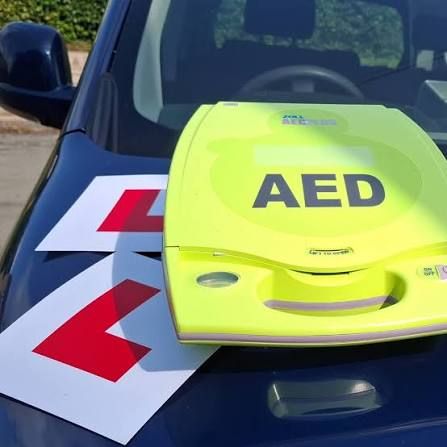
Life-Saving Science Behind the Wheel: How the 2026 DVSA Theory Exam First-Aid Update Works
When learner drivers prepare for the UK driving theory test, they typically focus on stopping distances, road signs, and hazard perception clips. However, the Driver and Vehicle Standards Agency (DVSA) has transformed the multiple-choice question bank to reflect real-world roadside emergencies.
Developed in partnership with Resuscitation Council UK and nation-wide "Save a Life" initiatives, car and motorcycle theory tests now include updated questions on Cardiopulmonary Resuscitation (CPR) and, for the first time, Automated External Defibrillators (AEDs).
With over 40,000 out-of-hospital cardiac arrests occurring in the UK every year and a survival rate below 10%, drivers—who are frequently first on the scene at road collisions or service stations—are positioned as critical first responders.
What Is Changing (and What Isn't)
No Extra Fees or Time: The exam structure remains 50 multiple-choice questions in 57 minutes (pass mark: 43/50) and 14 hazard perception clips (pass mark: 44/75) on GOV.UK.
No Practical Assessments: You do not need to perform physical CPR on a manikin during your practical exam. The update tests life-saving knowledge and decision-making under scenario-based conditions.
Modernized First-Aid Content: The legacy "DR-ABC" framework has been streamlined in favor of immediate, actionable emergency steps: Call 999 $\rightarrow$ Start CPR $\rightarrow$ Use an AED.
The 4 Core First-Aid Mechanics You Must Know for the Exam
1. Recognizing a Cardiac Arrest
A common exam scenario describes an unresponsive driver or pedestrian. A casualty is in cardiac arrest if they exhibit three signs together:
Unresponsive to touch or voice.
Not moving.
Not breathing normally (or not breathing at all).
Exam Action: Immediately call 999 (put it on speakerphone) and start chest compressions. If another person is present, direct them to retrieve the nearest public access AED.
2. Performing CPR (Rates and Depth)
The DVSA tests exact numerical parameters for effective chest compressions:
Hand Placement: Heel of one hand in the centre of the chest, with the other hand interlocked on top.
Compression Depth: Press down 5 to 6 cm into the chest.
Compression Rate: Maintain a rhythm of 100 to 120 compressions per minute (to the beat of "Stayin' Alive").
Ratio: 30 chest compressions to 2 rescue breaths (or continuous hands-only CPR if untrained).
3. Using an Automated External Defibrillator (AED)
Questions about public access AEDs focus on accessibility and operation:
Who Can Use It? Everyone. You do not need prior medical or first-aid training.
The First Step Upon Arrival: Open/switch on the AED unit. The machine will deliver automated voice and visual prompts guiding pad placement and safety precautions.
Can You Cause Harm? No. The machine analyzes the casualty's heart rhythm automatically and will only administer a shock if a shockable rhythm is detected.
4. Roadside Post-Crash Protocols
First-aid scenario questions also evaluate scene safety:
Never move an injured casualty from a vehicle unless there is an immediate risk of fire, explosion, or submersion.
Keep injured casualties warm, still, and calm while emergency services are en route.
Pass-First-Time Theory Preparation
Update Your Apps: Ensure your preferred revision app or software is synced with official DVSA revision updates.
Use Free Training Tools: Utilize bite-sized interactive resources like the British Heart Foundation RevivR tool to master 15-minute CPR and AED walk-throughs.
Take Timed Mock Tests: Practice scenario-based multiple-choice questions on GOV.UK to familiarize yourself with phrasing before sitting the official exam.